
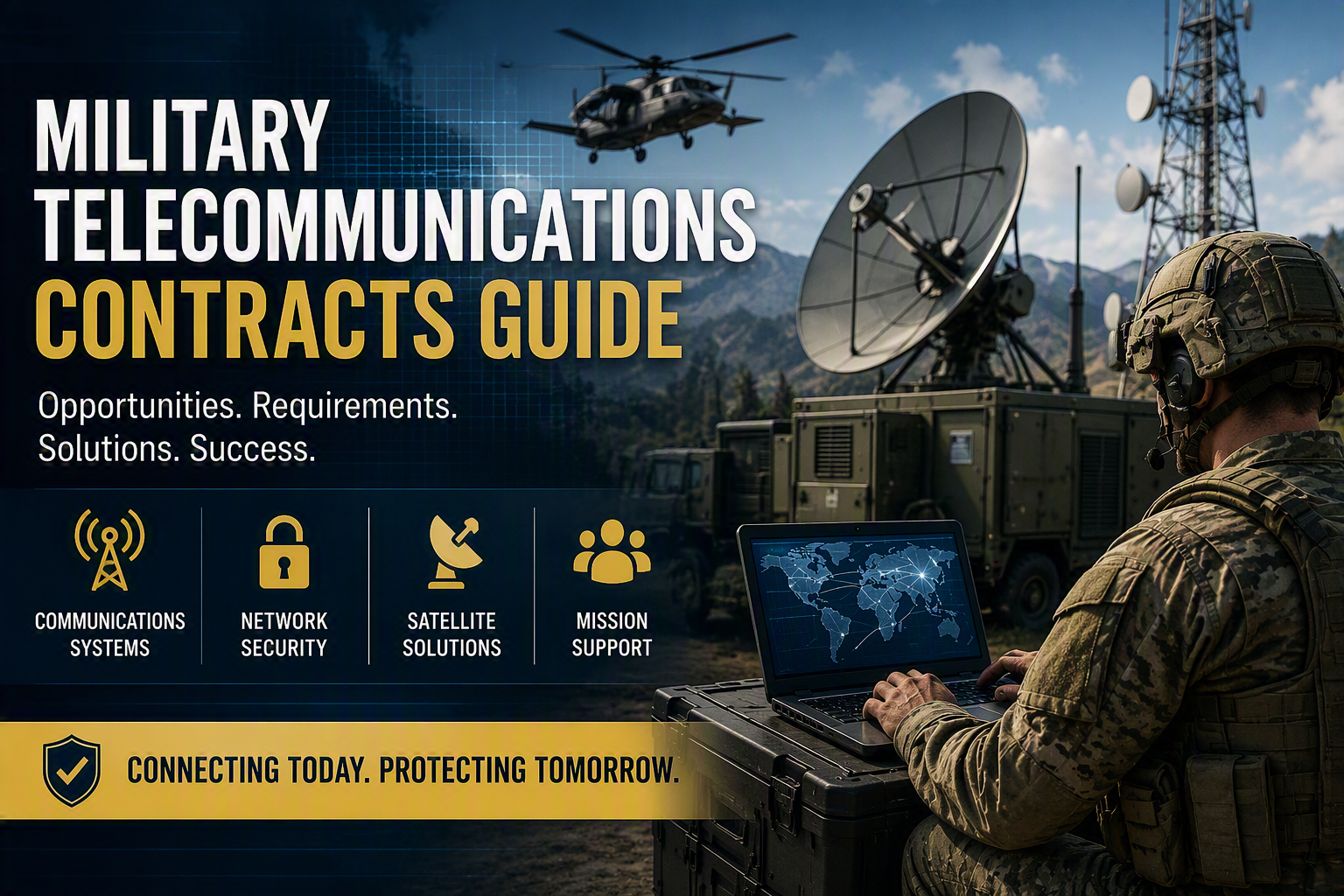
Telecommunications contracts in the defense sector represent one of the most strategically vital and technically complex segments of U.S. government international procurement. From secure satellite communications supporting deployed forces to enterprise-wide network infrastructure connecting command centers across multiple continents, these contracts form the backbone of how the military communicates.
We have worked with contractors pursuing opportunities across the full spectrum of defense communications, and one reality stands out above all others. The companies that win consistently in this space are not simply technology providers. They are firms that understand the intersection of technical capability, security compliance, and the specific acquisition structures the government uses to procure these mission-critical services.
Understanding the Defense Telecommunications Landscape
The military telecommunications market is not a single monolithic procurement channel. It is a complex ecosystem of centralized contract vehicles, specialized agencies, and layered compliance requirements that together govern how the Department of Defense and its supporting agencies acquire communications services and infrastructure worldwide.
Defense telecom contracts are managed primarily through Indefinite Delivery Indefinite Quantity vehicles that consolidate the government’s purchasing power across multiple agencies and geographic regions. This centralized approach ensures that the DoD can maintain consistent security standards, leverage volume pricing, and deploy communications capabilities rapidly when operational needs arise.
What makes this market particularly challenging for contractors is the simultaneous requirement to deliver cutting-edge commercial technology while meeting some of the most stringent security and compliance standards in any industry.
We consistently advise clients that success in military communications contracts requires mastery of both the technical and regulatory dimensions, and that weakness in either area will disqualify even the most capable technology provider.
Primary Contract Vehicles for Military Telecommunications
Several major contract vehicles dominate the landscape of telecommunications contracts in the defense market. Understanding which vehicle applies to a specific requirement, who manages it, and what the competitive landscape looks like under each vehicle is foundational intelligence for any serious capture strategy.
Enterprise Infrastructure Solutions
Enterprise Infrastructure Solutions, commonly known as EIS, is the DoD and GSA’s primary vehicle for enterprise telecommunications and networking infrastructure. With a ceiling of approximately fifty billion dollars, EIS covers an extraordinarily broad scope of services.
- LAN and WAN design, installation, and management
- Voice and unified communications services
- Managed network services and internet protocol connectivity
- Cloud connectivity and data transport
- Cable and wire plant installation and maintenance
EIS replaced the older Networx contracts and has become the mandatory acquisition path for most enterprise telecommunications requirements across federal agencies. For contractors, holding a position on EIS is a significant competitive asset that opens access to a steady flow of task order opportunities.
DoD Wireless Services
The Department of Defense Wireless Services vehicle, currently in its Spiral 4 iteration, is the centralized contract for unclassified wireless mobile services and devices across the DoD. All Department of Defense components are mandated to use this vehicle for their mobile telecommunications needs, which makes it one of the most consistently funded and actively utilized defense telecom contracts in the market.
Complex Commercial SATCOM Solutions
Known as CS3, this GSA IDIQ vehicle provides customized, secure satellite communication services and hardware specifically designed for deployed operations. For contractors with satellite communications capabilities, CS3 represents a direct path to supporting military forces in remote and austere environments where terrestrial communications infrastructure does not exist.
Joint Warfighting Cloud Capability
The JWCC is managed by DISA and connects the Defense Information Enterprise across all security domains and classification levels. This multi-cloud IDIQ represents the DoD’s commitment to modernizing its information infrastructure and provides opportunities for contractors with cloud computing, data management, and secure hosting capabilities.
Key Agencies and Authorities in Defense Telecommunications
Understanding which agencies control the acquisition, policy, and technical standards for telecommunications contracts is essential for effective market engagement and capture planning. Each agency plays a distinct role, and contractors must know who to engage, when to engage them, and what each agency prioritizes.
Defense Information Systems Agency
DISA serves as the Department of Defense’s combat support agency, responsible for planning, developing, and managing enterprise-level information network capabilities. For contractors pursuing military communications contracts, DISA is often the primary customer and the agency that defines technical requirements, manages major contract vehicles, and oversees network security standards across the entire defense communications enterprise.
DISA’s influence extends across virtually every aspect of defense telecommunications, including network architecture, cybersecurity policy enforcement, satellite communications management, and cloud infrastructure.
Department of Defense Chief Information Officer
The DoD CIO establishes overarching policy for information technology and telecommunications across the defense enterprise. Key policy areas that directly impact contractors include:
- Mandated wireless mobility programs and approved device standards
- Zero Trust architecture integration requirements
- Secure communications protocols and encryption standards
- Data management and interoperability mandates
Contractors must monitor DoD CIO policy releases closely because changes in policy frequently translate into new requirements, modified evaluation criteria, and shifts in acquisition priorities within existing contract vehicles.
General Services Administration
GSA administers government-wide acquisition contracts and Multiple Award Schedules that allow agencies to procure commercial IT and telecommunications hardware, software, and services through streamlined purchasing processes. GSA’s role in the telecommunications market includes managing major vehicles like EIS and CS3, maintaining the GSA eLibrary of approved vendors, and providing acquisition support to agencies that lack dedicated telecommunications procurement staff.
Compliance and Security Standards That Shape Every Contract
No discussion of telecommunications contracts in the defense sector is complete without a thorough examination of the compliance and security requirements that govern every aspect of contract performance. These are not optional enhancements. They are strict prerequisites that determine whether a contractor is even eligible to compete.
Cybersecurity Maturity Model Certification
CMMC requires defense contractors to implement and demonstrate specific cybersecurity standards to safeguard Controlled Unclassified Information. For telecommunications providers, this means that every element of your network infrastructure, data handling processes, and personnel security practices must meet the required certification level. The requirement extends throughout the subcontractor chain, which means your teaming partners must also maintain current CMMC certification.
Zero Trust and TIC 3.0 Compliance
The DoD has mandated that all network architectures supporting defense operations must implement Zero Trust frameworks. This represents a fundamental shift from perimeter-based security to a model where every device, user, and network connection is continuously verified regardless of location. Trusted Internet Connections 3.0 compliance further defines how defense networks connect to external resources securely, particularly in remote or tactical edge environments.
For contractors pursuing defense telecom contracts, demonstrating a mature Zero Trust implementation capability is rapidly becoming one of the most important technical discriminators in proposal evaluation.
Communication Service Authorizations
Under DFARS, Communication Service Authorizations are used in conjunction with basic agreements to authorize, fund, and manage specific telecommunication services. Contractors must understand how CSAs interact with the broader contract structure and how they affect billing, service activation, and modification processes throughout the contract lifecycle.
How to Find and Bid on Military Communications Contracts
One of the most common questions we receive from contractors entering the telecommunications contracts market is where to find relevant opportunities and how to navigate the bidding process effectively. The answer involves multiple information sources that must be monitored consistently and analyzed in context.
SAM.gov
SAM.gov is the central federal marketplace where all Department of Defense and federal agency contract opportunities are published. For military communications contracts, this includes RFPs, Sources Sought notices, Requests for Information, and pre-solicitation announcements.
However, relying solely on SAM.gov without additional context about agency priorities, incumbent performance, and historical spending patterns puts contractors in a reactive position that rarely produces wins.
AFCEA Signal Guide
The Armed Forces Communications and Electronics Association publishes an authoritative annual guide that breaks down major DISA and DoD IT and telecommunications contracts, identifies prime contractors, and documents periods of performance. This resource provides valuable competitive landscape intelligence that helps contractors understand who currently holds the work they are targeting.
GSA eLibrary
The GSA eLibrary allows contractors to identify approved telecommunications, SATCOM, and IT vendors holding current Multiple Award Schedule contracts. This resource is particularly useful for identifying potential teaming partners and understanding the competitive pool for specific categories of telecommunications services.
We strongly recommend that contractors supplement these public sources with structured procurement intelligence that provides deeper analysis of spending patterns, recompete timelines, and competitive dynamics specific to their target sectors. The difference between publicly available information and analyzed, actionable intelligence is often the difference between submitting a bid and winning a contract.
The Growing Importance of SATCOM and Tactical Communications
As military operations become increasingly distributed and reliant on real-time data sharing, satellite communications and tactical edge networking have become among the fastest-growing segments. Forward-deployed forces, special operations units, and diplomatic security teams all require secure, reliable communications in environments where traditional infrastructure is unavailable or compromised.
Contractors with capabilities in the following areas are finding growing demand across overseas defense telecom contracts and related vehicles.
- Deployable satellite communications terminals and ground stations
- Mobile ad-hoc networking solutions for tactical environments
- Secure voice and data communications for dismounted personnel
- Beyond-line-of-sight communications for maritime and aviation operations
- Integration of commercial satellite constellations with military networks
We see this segment continuing to grow as the DoD invests in modernizing its communications architecture to support multi-domain operations and joint all-domain command and control concepts. Contractors who position themselves early in this space with demonstrated operational experience and relevant past performance will have a significant competitive advantage as new requirements emerge.
Building a Winning Strategy for Defense Telecom Contracts
Competing effectively for military communications contracts requires a capture strategy that addresses both the technical and business dimensions of the opportunity simultaneously. We have observed that the most successful contractors in this market follow a consistent set of strategic disciplines.
Start With Intelligence
Before committing resources to any specific opportunity, invest in understanding the competitive landscape, the incumbent’s performance history, the agency’s stated modernization priorities, and the funding trajectory for the specific program or contract vehicle you are targeting. We provide this intelligence across all 19 sectors of overseas contracting, including telecommunications and IT.
Build Compliance Early
Do not wait until an RFP is released to begin addressing CMMC, Zero Trust, or other compliance requirements. These frameworks take months or years to implement properly, and evaluators can easily distinguish between mature compliance programs and hastily assembled documentation.
Develop Teaming Relationships Strategically
The breadth of services covered under major telecommunications vehicles means that very few contractors can credibly claim full-spectrum capability. Identify teaming partners whose capabilities complement your own and whose past performance strengthens your overall competitive position.
Demonstrate Operational Relevance
Past performance in commercial telecommunications, while valuable, does not carry the same weight as demonstrated experience in defense or government environments. Focus your proposal narrative on engagements where you delivered secure communications services under operational conditions that mirror the requirements of the opportunity you are pursuing.
Frequently Asked Questions
What is DISA’s role in military telecommunications contracting?
DISA serves as the combat support agency responsible for planning, developing, and delivering enterprise-level Department of Defense Information Network capabilities. DISA manages major contract vehicles, defines technical standards, and oversees network security across the defense communications enterprise.
What is the Enterprise Infrastructure Solutions contract?
EIS is the DoD and GSA’s primary vehicle for enterprise telecommunications and networking infrastructure with a ceiling of approximately fifty billion dollars. It covers services ranging from local and wide area networking to voice communications, cloud connectivity, and managed network services.
How does Zero Trust affect telecommunications contractors?
Zero Trust is a framework that continuously verifies every user, device, and connection, no matter where they are located. The DoD has mandated Zero Trust implementation across its network architecture, which means telecommunications contractors must demonstrate mature Zero Trust capabilities in their proposals and technical solutions.
What compliance certifications are required for defense telecom contracts?
At minimum, contractors must meet CMMC requirements appropriate to the sensitivity of the information they will handle. Additional requirements may include Zero Trust and TIC 3.0 compliance, ITAR and EAR export control certifications for international work, and Communication Service Authorization compliance under DFARS.
Can small businesses compete for military telecommunications contracts?
Yes. While major enterprise-wide telecommunications vehicles are typically held by large contractors, small businesses can compete for specialized task orders, niche technology requirements, and component-level services. Subcontracting to large primes holding positions on major vehicles like EIS is also a well-established and effective market entry strategy.
Connecting Strategy to Mission Success
The telecommunications contracts market within U.S. defense and international operations offers substantial and sustained opportunity for contractors who combine technical excellence with regulatory mastery and strategic intelligence. Every element of this guide contributes directly to a contractor’s ability to win and perform successfully in this demanding sector.
At International Contract Intelligence Group, we deliver the sector-specific intelligence and strategic advisory that telecommunications contractors need to navigate this complex market with confidence. Whether you are pursuing your first defense telecom contracts opportunity or looking to expand your presence across additional vehicles and theaters, we are ready to provide the data and guidance that turns ambition into awarded contracts.