
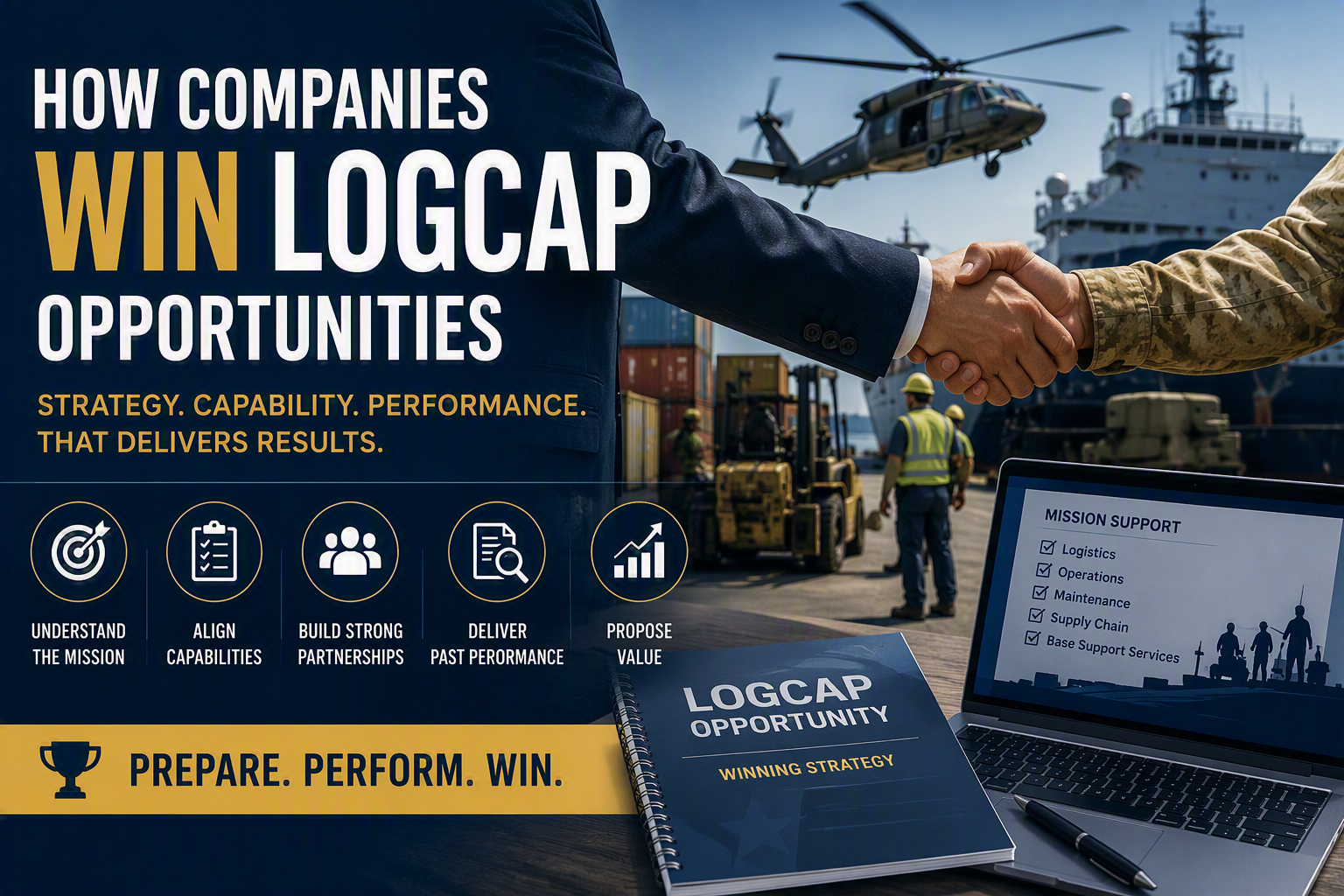
LOGCAP opportunities represent the pinnacle of military sustainment and overseas support for businesses operating in the defense sector. The Logistics Civil Augmentation Program serves as the primary mechanism for the U.S. Army to leverage private sector capabilities. We have spent years analyzing these complex requirements, and we understand that winning a position on this multi-billion-dollar vehicle requires more than just a standard proposal.
The transition from a domestic contractor to a player in the LOGCAP arena involves a significant shift in how a company views logistics, risk, and scalability. To help your organization navigate this high-stakes environment, we have compiled a comprehensive guide on the strategies that consistently lead to success in this competitive market.
The Magnitude of LOGCAP V and the Competitive Landscape
The current iteration of the program, known as LOGCAP V, represents a significant shift in how the U.S. government approaches sustainment contracting. With an eighty-two-billion-dollar ceiling and a performance period spanning a decade, the stakes have never been higher for contractors seeking a position in this market.
LOGCAP V is organized primarily around geographic regions where specific prime contractors hold Single Award Task Order Contracts, commonly referred to as SATOCs. These regional awards cover critical operational theaters including CENTCOM, EUCOM, and AFRICOM. Understanding which theater aligns with your company’s capabilities and geographic experience is one of the first and most consequential decisions in the entire capture process.
The market is not limited to large prime integrators. Significant LOGCAP opportunities exist for firms that can provide niche services or act as reliable and well-qualified subcontractors. The Army also utilizes Multiple Award Task Order Contracts, known as MATOCs, for requirements within the continental United States and for specific contingency missions that benefit from a broader pool of competitors.
We emphasize that companies must make a clear determination about whether they are positioned to operate as a prime integrator or as a specialized provider of contingency logistics services before investing meaningful resources into their capture strategy.
Demonstrating Global Scalability and Surge Capacity
The most critical factor in winning a task order under this program is the ability to prove that your organization can scale from zero to full operational capacity within a matter of days. The Army frequently requires contractors to establish full base operations and complete life support within a seventy-two-hour window, often in austere or hostile environments where traditional infrastructure is entirely absent.
A winning submission in this area typically demonstrates the following capabilities:
- Documented global supply chain networks with verified reach into priority operational theaters.
- Pre-negotiated vendor agreements that can be activated immediately upon task order award.
- A verified roster of personnel cleared, credentialed, and ready for rapid overseas deployment.
- Tested crisis action plans that have been exercised in real contingency environments.
- Proven ability to scale operations up or down quickly in response to shifting geopolitical conditions.
We have found that the most successful bidders include specific and verifiable examples of how their organizations handled sudden spikes in demand during previous contingency missions. The government values reliability and speed above almost all other factors when evaluating LOGCAP contracts, and every element of your surge capacity narrative must be supported by documented, verifiable evidence rather than aspirational claims.
The Importance of Past Performance in Contingency Operations
Past performance acts as the bedrock of a credible bid in the world of contingency logistics. The Army is understandably hesitant to trust a mission-critical requirement to a firm that has not already demonstrated success in high-stakes overseas environments. Incumbents often carry a natural advantage because they have already navigated the complexities of international labor laws.
We suggest that newer entrants focus specifically on highlighting their experience in comparable overseas environments, even if those projects were smaller in scale or performed in a subcontract role. The key is relevance, not size.
Your past performance submissions should include:
- Quantitative metrics that verify your record of sustained service delivery.
- Documented examples of managing supply chain disruptions under operational pressure.
- Evidence of uninterrupted life support services including dining, power, and billeting.
- Verifiable accounts of how your team responded to security threats or environmental challenges.
- References from contracting officers who can speak directly to your reliability in theater.
Risk mitigation is the core theme the Army evaluates in this section. By presenting metric-supported narratives that show how your firm has performed under pressure, you build the trust with procurement officers that translates directly into competitive evaluation scores.
Assembling Complementary Teaming Structures
Because the scope of LOGCAP opportunities is so vast, very few companies possess the full range of capabilities required to handle every element of a task order independently. The work spans everything from aircraft maintenance and facility operations to morale, welfare, and recreation services. The most formidable bids consistently come from Joint Ventures or carefully assembled teams that combine large defense contractors with niche small business providers who fill specific capability gaps.
We have seen prime contractors actively seek partners who bring regional expertise or specialized technical certifications that the prime itself cannot credibly claim. By positioning your firm as an essential and well-documented piece of a larger teaming structure, you significantly increase your probability of inclusion in a winning bid for LOGCAP contracts.
When building or joining a team, focus on the following strategic considerations:
- Identify capability gaps in potential prime contractors operating in your target theater.
- Pursue relationships with firms whose past performance complements rather than duplicates your own.
- Structure teaming agreements that clearly define roles, responsibilities, and past performance attribution.
- Engage potential partners at industry days and pre-solicitation events well before RFP release.
- Ensure your firm’s specific contribution is distinct, documented, and defensible during proposal evaluation.
Small businesses should specifically look for opportunities within CONUS-based MATOCs or by targeting the subcontracting goals that prime contractors are contractually obligated to fulfill. Early engagement and a clear contractual definition of each partner’s contribution ensures the final proposal reads as a cohesive and credible integrated solution.
Ensuring Regulatory and Cybersecurity Compliance
Compliance in the defense contracting world is not a competitive differentiator. It is a threshold requirement that must be fully satisfied before any other element of a proposal is even considered. For any firm pursuing LOGCAP opportunities, having a mature and demonstrable cybersecurity posture is mandatory across the entire supply chain.
Cybersecurity Maturity Model Certification
The CMMC framework has become a central element of the evaluation process. The required certification level applies not just to the prime contractor but to every subcontractor in the teaming structure. We advise all contractors to verify that their IT infrastructure and that of their partners meets DoD standards well before bid preparation begins.
A cybersecurity failure is treated as a mission readiness failure, and it will end a proposal’s competitiveness regardless of every other strength the submission demonstrates.
Cost Accounting and Financial Transparency
Because many task orders incorporate cost-based contract line items, your firm must demonstrate an ability to track expenditures with precision and full transparency. The key requirements in this area include:
- Accounting systems that are fully compliant with Federal Acquisition Regulations.
- The ability to withstand rigorous government audits without material findings.
- Transparent cost models that clearly separate direct costs, indirect costs, and fee structures.
- Experienced cost accounting personnel who understand the nuances of government cost reporting.
We have seen otherwise qualified companies lose competitions because their financial systems could not meet government transparency requirements. Investing in compliant financial infrastructure is not overhead. It is a prerequisite for serious participation in this market.
Engaging Early and Leveraging Modern Technology
Waiting for a final Request for Proposals to be released before beginning capture activity is one of the most consistent predictors of a losing outcome in the LOGCAP opportunities market. The companies that win are the ones that participate in Army industry days, engage with program officials during pre-solicitation phases, and submit thoughtful questions during draft RFP periods to help shape the acquisition direction in ways that favor their demonstrated strengths.
This early engagement is not simply about relationship building. It provides direct insight into the specific operational pain points the government is trying to solve in a particular theater, which is invaluable context when it comes time to write a differentiated technical proposal.
Beyond early engagement, the Army is placing increasing value on technological sophistication in contingency logistics management. Contractors who demonstrate the integration of the following capabilities consistently stand out:
- AI-powered inventory tracking systems that provide real-time supply chain visibility.
- Predictive maintenance platforms that reduce equipment downtime in austere environments.
- Digital asset management systems that support accountability across distributed operational sites.
- Data analytics tools that allow rapid identification and resolution of logistics bottlenecks.
We believe that technological innovation has become one of the most important differentiators in the modern contingency contracting market. Companies that invest in these capabilities early will find themselves with a meaningful and sustained competitive advantage that is difficult for less prepared competitors to overcome.
Navigating International Transaction Complexity
Performing on LOGCAP contracts means confronting the realities of international business operations on a daily basis. This involves navigating host nation labor laws, customs requirements, international tax treaties, and the bureaucratic processes of foreign governments, often simultaneously and often under significant time pressure.
We have observed that many contractors underestimate the administrative burden of operating across multiple foreign jurisdictions at the same time. Your proposal should directly address how your organization plans to manage these complexities without creating delays or disruptions to mission support.
Having a dedicated team of legal and financial professionals who specialize in international transactions is a meaningful competitive advantage that evaluators recognize and value.
You must be able to demonstrate that your firm can pay local vendors on time, resolve customs disputes efficiently, and maintain full financial compliance across multiple regulatory environments simultaneously. This level of operational sophistication is precisely what the Army expects from its top-tier sustainment partners.
The Role of Intelligence in Winning LOGCAP Opportunities
The most successful companies pursuing LOGCAP opportunities do not rely on assumptions or informal market knowledge to guide their decisions. They use structured, verified intelligence to determine which opportunities align with their capabilities, which incumbents are vulnerable, and where the best probability of success exists across the competitive landscape.
Strong competitive intelligence in this market includes:
- Historical spending analysis across LOGCAP task orders by theater and service category.
- Incumbent contractor performance data available through public past performance databases.
- Budget trend monitoring across relevant operational commands and geographic theaters.
- Competitive landscape mapping that identifies teaming gaps and partnership opportunities.
- Country-specific risk profiles for operational theaters under active consideration.
We provide this kind of structured intelligence across the full landscape of overseas contracting, including the LOGCAP market. We consistently see that the firms with the best data are the ones that end up on the winning side of the contract award. In a market this competitive, being well-informed is just as important as being well-equipped.
Frequently Asked Questions
What is the main purpose of the LOGCAP program?
The program is designed to provide the U.S. Army with a flexible and rapid mechanism to secure private sector support for global military operations. It focuses on troop sustainment, life support, and base operations, allowing uniformed personnel to concentrate on their primary combat or diplomatic missions rather than logistics functions.
How long do LOGCAP contracts typically last?
The overarching IDIQ vehicles like LOGCAP V are structured to last up to ten years, including an initial base period followed by several option years. Individual task orders issued under the vehicle carry their own performance periods, which vary depending on the scope and nature of the requirement.
Can small businesses bid as prime contractors on LOGCAP?
Most of the large regional SATOCs are awarded to major defense contractors due to the immense scale and financial requirements involved. However, small businesses can bid as primes on smaller CONUS-based task orders and can participate as essential subcontractors to large primes, particularly through the mandatory small business subcontracting goals that primes are required to fulfill.
What are the most common services provided under LOGCAP contracts?
The most frequent services include dining facility operations, laundry, housing, waste management, and power generation. Other common requirements involve supply chain management, transportation of equipment and personnel, and the maintenance of facilities and vehicles at forward operating bases and main operating bases in theater.
Is cybersecurity compliance required for all subcontractors?
Yes. The Department of Defense requires that all contractors and subcontractors in the supply chain meet specific cybersecurity standards under the CMMC framework. Firms must demonstrate that they can protect sensitive government information at the required certification level. Failure to meet these standards may result in exclusion from a teaming arrangement or disqualification from a specific task order competition.
The Strategic Path to Sustained Success
Winning a place in the competitive landscape of military sustainment requires a blend of operational excellence, regulatory precision, strategic foresight, and high-quality competitive intelligence. The journey to securing LOGCAP opportunities is often long and demanding, but the rewards for well-prepared firms are unmatched anywhere in the federal contracting market.
At International Contract Intelligence Group, we provide the actionable sector intelligence, capture support, and strategic guidance that defense contractors need to compete with confidence in this demanding market. If LOGCAP is part of your growth strategy, we are ready to help you build the foundation to win.