
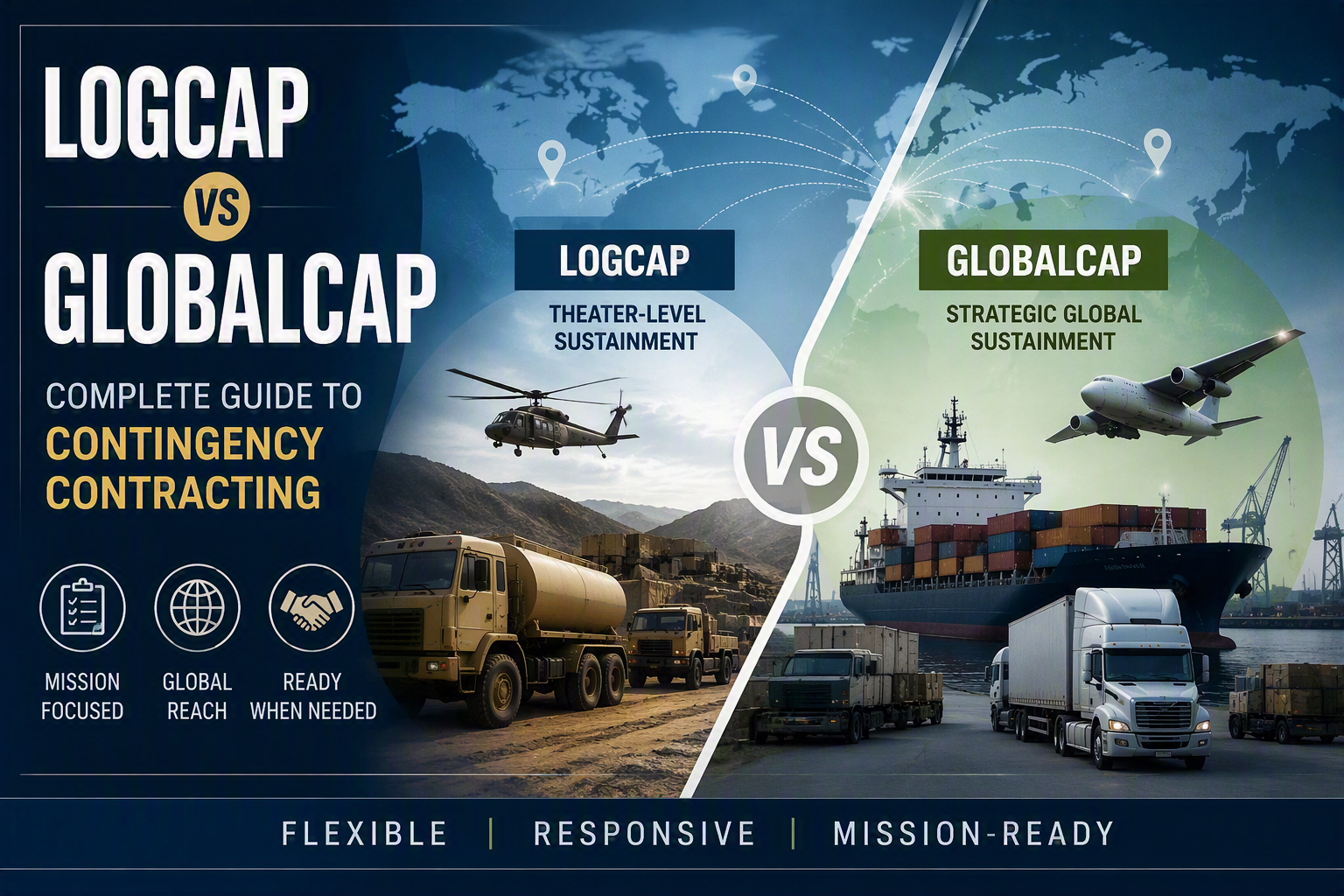
LOGCAP and GLOBALCAP represent two of the most significant and strategically consequential contract vehicles in the U.S. government’s overseas contracting arsenal. For defense and diplomatic contractors looking to build a serious presence in the global contingency contracts market, understanding how these two programs work, where they differ, and what it takes to compete within them is not optional knowledge. It is foundational.
We have worked extensively with contractors navigating both vehicles, and the confusion between the two programs is one of the most common and costly mistakes we encounter. While both LOGCAP contracts and GLOBALCAP contracts operate as large-scale Indefinite Delivery Indefinite Quantity vehicles, they serve fundamentally different missions, agencies, and geographic priorities. Getting that distinction right from the start shapes every element of a contractor’s positioning strategy.
What Is LOGCAP and How Does It Work
The Logistics Civil Augmentation Program, universally known as LOGCAP, is the U.S. Army’s primary vehicle for contracting private sector support to sustain military forces in the field. Managed by the Department of Defense, LOGCAP was designed to allow the Army to rapidly mobilize contractor support during contingency operations without the delays that would come from standing up new contracts from scratch each time a crisis emerges.
LOGCAP operates as a multi-billion-dollar IDIQ umbrella contract. The current iteration, LOGCAP V, carries an estimated ceiling of approximately 82 billion dollars, which reflects the extraordinary scale of services the Army requires to sustain troops across global operational theaters. That ceiling also signals the magnitude of opportunity available to contractors who are properly positioned to compete for task orders under the vehicle.
What LOGCAP Covers
LOGCAP contingency logistics support is almost entirely focused on keeping military forces sustained and operational in the field, freeing combat personnel to focus on mission execution rather than base support functions. The core task order categories include:
- Life support services, including billeting, dining facility operations, laundry, and waste management.
- Base construction encompassing temporary and semi-permanent camp construction and infrastructure.
- Logistics and supply chain management, including troop and equipment transportation, warehousing, and fuel distribution.
- Maintenance and facilities management across forward operating bases and main operating bases.
- Communications infrastructure and information technology support in theater.
LOGCAP’s primary geographic footprint is concentrated in CENTCOM, EUCOM, and AFRICOM operational areas, though the vehicle’s structure allows for global deployment wherever the Army has a sustainment requirement.
What Is GLOBALCAP and How Does It Work
GLOBALCAP, which stands for the Global Contingency and Assistance Program, is a fundamentally different vehicle managed not by the Department of Defense but by the U.S. Department of State. Where LOGCAP is built around military sustainment, GLOBALCAP is designed to support civilian foreign policy objectives, partner nation capacity building, and peacekeeping operations in fragile or conflict-affected environments.
The GLOBALCAP contract vehicle carries a ceiling of 5 billion dollars over a ten-year period and is funded through Peacekeeping Operations appropriations and Economic Support Funds rather than the Defense Department’s Operations and Maintenance budget. This distinction matters because it reflects the fundamentally different stakeholder environment, mission set, and performance expectations that contractors encounter under each vehicle.
What GLOBALCAP Covers
GLOBALCAP global contingency contracts are organized around five core capability areas that reflect the State Department’s foreign policy and stabilization mission priorities:
- Training and mentoring programs for civilian law enforcement, rule of law development, and human rights capacity building.
- Logistics support for partner nation forces, including supply chain management and medical support.
- Equipment procurement covers a wide range, from personal protective equipment to unmanned aerial surveillance systems.
- Construction services, including maritime engineering, facility refurbishment, and training camp construction.
- Program management and advisory support for foreign assistance initiatives.
GLOBALCAP’s primary geographic focus is Sub-Saharan Africa, though the vehicle’s structure provides global scalability that allows task orders to be issued wherever State Department requirements arise. For contractors with relevant capabilities and regional experience in African markets, GLOBALCAP represents a particularly well-aligned opportunity.
LOGCAP vs GLOBALCAP: The Core Differences That Shape Strategy
Understanding the distinctions between these two vehicles is not simply an academic exercise. It directly determines which companies are realistic competitors, what past performance is considered relevant, how proposals are evaluated, and what operational capabilities a contractor must demonstrate to be taken seriously.
| Feature | LOGCAP | GLOBALCAP |
| Primary Agency | U.S. Army, Department of Defense | U.S. Department of State |
| Mission Focus | Military troop sustainment and base operations | Peacekeeping and partner nation capacity building |
| Funding Source | DoD Operations and Maintenance funds | Peacekeeping Operations and Economic Support Funds |
| Contract Ceiling | Approximately 82 billion dollars | 5 billion dollars over ten years |
| Primary Geographic Focus | CENTCOM, EUCOM, AFRICOM military theaters | Sub-Saharan Africa with global scalability |
| Contract Type | IDIQ with FFP and Cost-Reimbursable task orders | IDIQ with FFP and Cost-Reimbursable task orders |
The funding source difference is particularly significant from a contractor’s perspective. DoD Operations and Maintenance funding follows a different appropriations timeline and congressional oversight structure than State Department Peacekeeping Operations funds. Contractors must understand how these funding streams affect task order issuance timing, modification authority, and the overall pace of procurement activity under each vehicle.
How Task Orders Work Under Both Vehicles
Because both LOGCAP and GLOBALCAP operate as IDIQ vehicles, the government does not guarantee a substantial payout simply by virtue of holding a position on the contract. The real competition happens at the task order level, where contractors who hold positions on the base vehicle compete against each other for specific, funded work packages as operational requirements emerge.
This structure has several important implications for contingency contracts strategy:
Task Order Competition Is Ongoing
Winning a position on either vehicle is not the finish line. It is the starting line. Contractors must maintain active capture programs, strong agency relationships, and current operational intelligence to compete effectively for task orders throughout the life of the contract. We consistently advise clients that the resource investment required to hold and leverage a position on a major IDIQ like LOGCAP or GLOBALCAP is substantial and must be planned for explicitly.
Requirements Emerge From Operational Conditions
Unlike predictable program-of-record acquisitions, contingency logistics task orders frequently emerge in response to rapidly evolving operational conditions. A conflict escalation, a peacekeeping mission expansion, or a sudden partner nation training requirement can trigger a task order competition with a compressed response timeline. Contractors who maintain current situational awareness and pre-positioned proposal resources are significantly better positioned than those who operate reactively.
Contract Types Vary by Task Order
Both vehicles make use of Firm-Fixed-Price and Cost-Reimbursable contract line items within individual task orders. The choice of contract type for a specific task order depends on the nature of the work, the risk profile of the requirement, and the government’s confidence in its ability to define the scope precisely. Understanding which contract type a specific task order is likely to use informs pricing strategy, risk allocation, and subcontract structure decisions.
What Contractors Need to Compete Effectively
Competing for LOGCAP contracts or GLOBALCAP contracts requires a distinct combination of demonstrated capability, relevant past performance, and structured intelligence about the competitive environment. The barriers to entry are real, and they are designed to be. The government needs to have confidence that any contractor operating in a contingency environment can perform under pressure, in austere conditions, and with minimal margin for error.
Past Performance Requirements
Both vehicles place significant weight on past performance that is directly relevant to contingency operations. For LOGCAP, this means demonstrated experience in life support, base operations, logistics, or construction in deployed military environments. For GLOBALCAP, relevant past performance typically includes foreign assistance program management, partner nation training, or stabilization operations experience. Domestic contract experience alone is rarely sufficient to establish the credibility evaluators are looking for.
Operational Capability Demonstration
Contractors must demonstrate the organizational capacity to mobilize quickly, sustain operations in resource-constrained environments, and manage complex subcontractor and supply chain relationships in foreign countries. This is not simply a matter of writing compelling proposal narratives. It requires having the actual infrastructure, personnel, and systems in place before the task order competition begins.
Teaming Strategy
Given the scale and scope of both vehicles, teaming is not just advisable. It is often essential. Identifying the right teaming partners, understanding their existing positions and past performance under each vehicle, and structuring agreements that create genuine competitive differentiation requires dedicated intelligence and relationship development work that begins well before any specific task order competition is announced.
Why Intelligence Is the Deciding Factor in Contingency Contracting
The contingency contracting market moves faster, responds to more unpredictable triggers, and carries higher operational stakes than almost any other segment of overseas government contracting. In that environment, the quality of a contractor’s intelligence infrastructure is often the single most important determinant of competitive success.
We provide sector-specific intelligence across the full landscape of global contingency contracts, giving contractors the visibility they need to anticipate task order activity, understand the competitive environment, and make resource allocation decisions with confidence.
The companies that win consistently in the LOGCAP and GLOBALCAP space do not wait for task order announcements to begin preparing. They are already positioned when the requirement emerges because their intelligence capabilities told them it was coming.
Frequently Asked Questions
Can a small business compete for LOGCAP or GLOBALCAP contracts?
Small businesses can participate in both vehicles, most commonly through subcontracting arrangements with large prime contractors who hold positions on the base IDIQ. Some task orders or specific capability areas within each vehicle may also offer small business set-aside opportunities. Building a track record as a subcontractor on contingency logistics work is often the most practical path for smaller companies to develop the past performance needed to pursue larger roles over time.
What is the difference between Firm-Fixed-Price and Cost-Reimbursable task orders under these vehicles?
Firm-Fixed-Price task orders pay the contractor a set amount regardless of actual costs incurred, placing cost risk on the contractor. Cost-Reimbursable task orders reimburse the contractor for allowable costs plus a fee, placing more cost risk on the government. Both types appear in LOGCAP and GLOBALCAP task orders, and the appropriate pricing strategy differs significantly between them.
How does GLOBALCAP differ from other State Department contract vehicles?
GLOBALCAP is specifically structured for contingency and foreign assistance requirements that demand rapid, flexible response capabilities. It differs from other State Department vehicles in its emphasis on peacekeeping operations, partner nation capacity building, and the ability to scale quickly in response to emerging foreign policy requirements. Its Sub-Saharan Africa focus also distinguishes it from broader global contracting vehicles.
How are LOGCAP task orders typically structured?
LOGCAP task orders are typically structured around a defined statement of work covering specific life support, logistics, or construction services at a specific location or set of locations. They include performance metrics, quality standards, key personnel requirements, and, in most cases, a combination of Firm-Fixed-Price and Cost-Reimbursable contract line items covering different elements of the required services.
What role does past performance play in LOGCAP and GLOBALCAP task order competitions?
Past performance is one of the most heavily weighted evaluation factors in both vehicles. Evaluators look for directly relevant experience in contingency environments, with demonstrated ability to perform under operational pressure, manage complex subcontractor relationships, and maintain quality standards in austere overseas settings. Building a documented record of relevant past performance is a long-term strategic investment.
Where Preparation Meets Opportunity
The LOGCAP and GLOBALCAP vehicles represent some of the most significant and enduring opportunities in the entire overseas contracting landscape. But they reward only those contractors who approach them with the right combination of operational capability, relevant past performance, strategic intelligence, and sustained competitive discipline.
Understanding the difference between these two is the starting point for any serious market entry strategy. At International Contract Intelligence Group, we provide the intelligence and strategic guidance that contractors need to navigate the contingency contracting market. If LOGCAP, GLOBALCAP, or the broader global contingency contracts landscape is part of your growth strategy, we are ready to help you build the foundation to compete and win.